
News News
Cricket Bat Performance Factors: Maximising Your Game Cricket Bat Performance Factors: Maximising Your Game
Most amateur and semi-professional players still trust the old ‘tapping test,’ yet scientific studies show this british tradition often misleads more than it helps. With up to 40 percent of players selecting suboptimal bats due to common misconceptions, understanding what really drives cricket bat performance has never been more crucial. This guide uncovers the true factors behind batting power and control, arming you with expert-backed knowledge to choose the right bat and give your game a british-inspired edge.
Table of Contents
- Defining Cricket Bat Performance And Misconceptions
- Materials, Shapes And Bat Classifications
- How Sweet Spot And Balance Affect Power
- Role Of Player Style And Format Requirements
- Technological Advances And Smart Bat Features
- Common Mistakes When Selecting A Bat
Key Takeaways
| Point | Details |
|---|---|
| Understand Bat Performance Factors | Performance is influenced by balance, weight distribution, and sweet spot location rather than just subjective assessments. |
| Choose Appropriate Bat for Format | Select a bat that aligns with your playing style and the specific requirements of Test, ODI, or T20 formats. |
| Embrace Technological Advances | Consider using sensor-enabled bats for real-time feedback and performance analysis to improve your game. |
| Avoid Common Selection Mistakes | Test bats personally and avoid relying solely on subjective criteria or a one-size-fits-all approach. |
Defining Cricket Bat Performance and Misconceptions
Cricket bat performance is a nuanced concept extending far beyond mere physical specifications. Research reveals that batting expertise involves complex interactions between perceptual-motor skills and psychological strategies, challenging traditional assumptions about what constitutes superior bat performance.
Many players mistakenly believe subjective assessments like the traditional ‘tapping test’ provide reliable performance indicators. Scientific investigations have demonstrated these methods are inconsistent and lack objective measurement precision. Performance actually encompasses multiple interconnected factors: wood quality, weight distribution, pick-up characteristics, sweet spot location, and player technique.
Key performance factors include:
- Balance: How evenly weight is distributed across the bat
- Pick-up: The bat’s perceived weight when lifted
- Sweet Spot: Area delivering maximum power and control
- Grain Structure: Wood’s natural fibre alignment affecting durability
- Edge Profile: Thickness and shape influencing shot execution
Pro tip: Always test a cricket bat personally, understanding that subjective feel matters as much as technical specifications.
Materials, Shapes and Bat Classifications
Cricket bat design has undergone significant transformation, with research documenting a comprehensive evolution of materials and structural characteristics that impact performance. Historically, bats were crafted from solid wood, but modern engineering has introduced sophisticated composite materials and layered designs that dramatically enhance player capabilities.
Contemporary bat classifications reflect intricate variations in structural design, optimising performance across different playing styles and techniques. The primary material remains willow wood, renowned for its exceptional combination of strength and flexibility. Manufacturers now carefully engineer bat profiles to address specific player requirements, considering factors like weight distribution, edge thickness, and blade geometry.
Primary bat classifications include:
- English Willow: Premium grade, used by professional players
- Kashmir Willow: More affordable, suitable for recreational cricket
- Power Bats: Thick edges, designed for aggressive batting
- Traditional Bats: Thinner profile, emphasising technical precision
- Player Specific: Customised to individual batting techniques
Pro tip: Select a bat that complements your natural batting style rather than attempting to adapt your technique to the bat’s characteristics.
How Sweet Spot and Balance Affect Power
Advanced research into cricket bat performance reveals critical insights about the intricate relationship between sweet spot placement and overall batting power. The sweet spot represents a precise area on the bat where maximum energy transfer occurs, fundamentally determining the efficiency of ball striking and subsequent shot power.

Scientific analysis demonstrates that bat balance plays a pivotal role in controlling power delivery and shot effectiveness. A well-balanced bat allows players to generate momentum more naturally, with the sweet spot’s location critically influencing the rebound effect and energy transmission during ball impact. Professional bat designers meticulously calculate weight distribution to optimise these performance characteristics.
Key aspects of sweet spot and balance include:
- Longitudinal Balance: Weight distribution along the bat’s length
- Lateral Balance: Symmetrical weight across the bat’s width
- Sweet Spot Location: Typically 10-15 cm from the bat’s shoulder
- Mass Concentration: How weight is clustered within the bat’s profile
- Vibration Dampening: Reducing unwanted energy loss during impact
Pro tip: Physically test multiple bats to understand how subtle variations in balance and sweet spot location can dramatically transform your batting performance.
Role of Player Style and Format Requirements
Advanced research highlights the intricate relationship between player style, match format, and cricket bat selection, revealing that equipment choices are far more nuanced than simply selecting a standard bat. Different cricket formats demand unique equipment characteristics, with Test matches, One Day Internationals (ODIs), and Twenty20 tournaments each requiring specialised bat configurations.
Environmental and task-specific constraints fundamentally influence bat selection, with player technique and competitive context driving equipment adaptations. A Test match batsman might prefer a heavier bat with robust construction for prolonged play, while a T20 specialist would opt for a lighter, more aggressive design that facilitates rapid scoring and enhanced bat speed.
Key considerations for bat selection across formats include:
- Test Cricket: Heavier bats with larger sweet spots
- ODI Cricket: Balanced bats supporting both defensive and attacking play
- T20 Cricket: Lighter bats maximising power and bat speed
- Player Technique: Defensive players prefer different bat profiles compared to aggressive hitters
- Pitch Conditions: Varying bat characteristics based on surface hardness and bounce
Pro tip: Invest in multiple bats tailored to different match formats, understanding that a single bat cannot effectively serve all playing contexts.
The following table compares cricket bat choices for different player types and match formats:
| Player Type/Format | Preferred Bat Profile | Performance Advantage | Consideration |
|---|---|---|---|
| Test Specialist | Heavy, robust construction | Greater shot durability | Suited for long batting periods |
| ODI All-Rounder | Balanced, mid-weight | Versatile defensive and attack | Adaptable to changing needs |
| T20 Aggressive Batsman | Light, thick edges | Increased bat speed, more power | Optimises rapid scoring |
| Defensive Technique | Thin, precise profile | Better control and accuracy | Reduces risk of mistimed shots |
| Spin Pitch Adaptation | Custom blade geometry | Improved handling on variable pitch | Enhanced grip and control |
Technological Advances and Smart Bat Features
Cutting-edge research demonstrates the transformative potential of sensor-enabled cricket bats, integrating machine learning and advanced technology to revolutionise player performance analysis. These intelligent sporting implements are no longer passive equipment, but active performance monitoring devices capable of capturing intricate details about batting techniques.
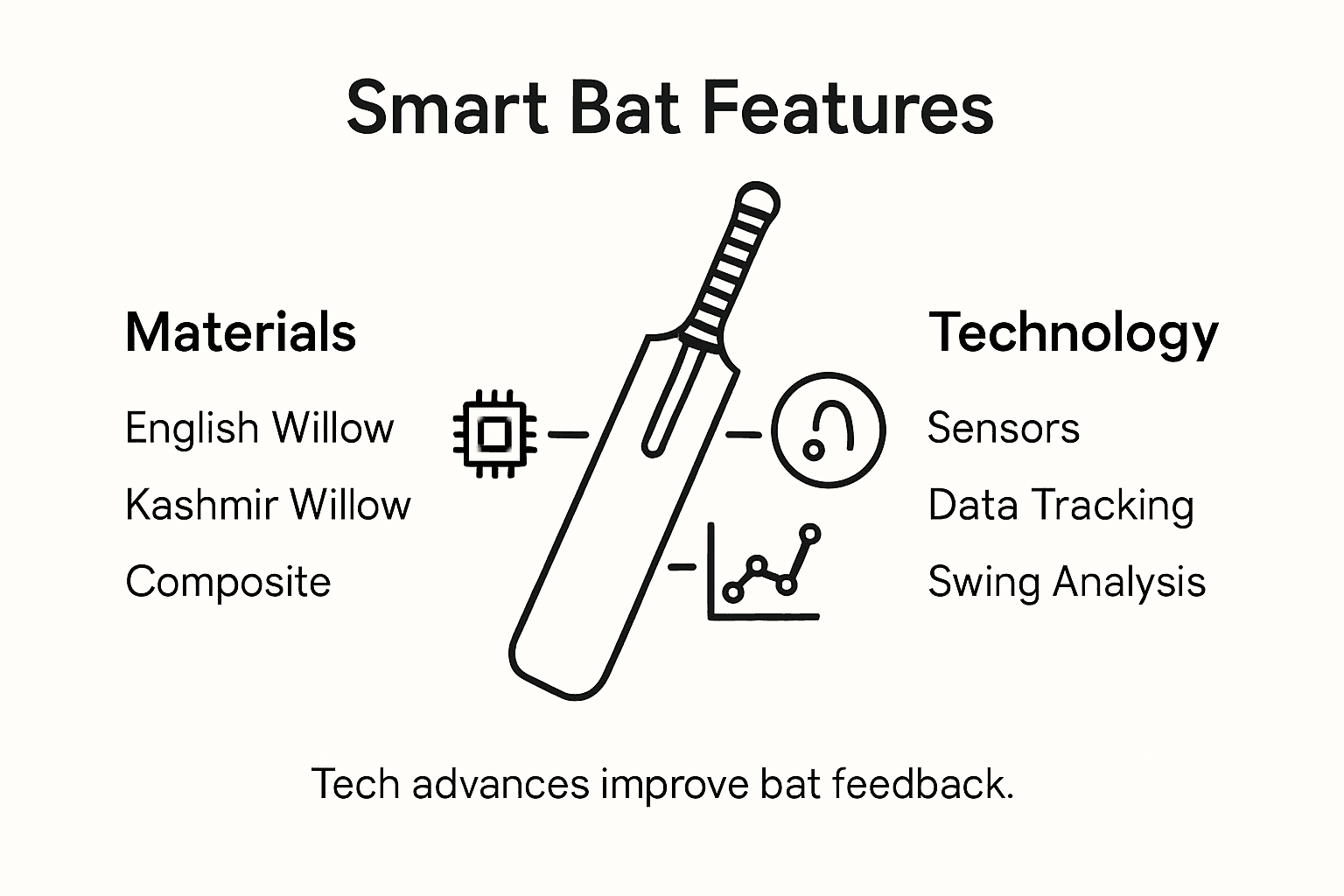
Artificial intelligence and embedded sensor technologies are enabling unprecedented levels of precision in tracking and evaluating cricket bat performance. Modern smart bats can now provide real-time data on critical metrics such as bat speed, impact location, stroke quality, and biomechanical efficiency, giving players and coaches granular insights into technical execution.
Key technological innovations include:
- Impact Sensors: Tracking precise moment and location of ball contact
- Motion Tracking: Capturing bat swing trajectory and speed
- Performance Analytics: Generating comprehensive stroke performance reports
- Machine Learning Algorithms: Personalising training recommendations
- Wireless Data Transmission: Instant performance feedback to coaches
Pro tip: Embrace technological insights, but remember that raw data must be interpreted through the lens of individual playing style and technique.
Here is a quick reference for recent technological innovations in modern cricket bats:
| Technology | Main Function | Benefit for Player |
|---|---|---|
| Embedded Impact Sensors | Record precise contact location | Analyse shot technique accuracy |
| Motion Tracking Units | Track swing trajectory and speed | Help refine timing and strokeplay |
| Wireless Data Transfer | Send live data to coaches | Enable instant feedback sessions |
| Machine Learning Tools | Generate tailored training plans | Support personalised improvement |
Common Mistakes When Selecting a Bat
Research reveals that many cricketers make critical errors in bat selection by relying on subjective assessments rather than objective performance metrics. These mistakes can significantly compromise batting performance and increase the risk of equipment-related limitations during crucial gameplay moments.
Players frequently overlook essential environmental and individual constraints when choosing cricket bats, leading to suboptimal equipment choices. Understanding these nuanced selection factors is paramount to ensuring that your bat complements your unique playing style and competitive environment.
Common bat selection mistakes include:
- Ignoring Personal Technique: Selecting a bat incompatible with individual batting style
- Relying on Tapping Tests: Using unreliable subjective assessment methods
- Neglecting Format Requirements: Choosing a single bat for all cricket formats
- Overlooking Weight Distribution: Disregarding bat balance and sweet spot location
- Price-Driven Decisions: Prioritising cost over performance characteristics
Pro tip: Always test multiple bats personally, focusing on how the bat feels and performs with your specific batting technique rather than relying solely on recommendations or price.
Elevate Your Game with the Right Cricket Bat
Understanding the critical factors that influence cricket bat performance such as balance, sweet spot location, and pick-up can transform your batting experience. If you have ever struggled to find a bat that complements your unique style or felt unsure about how bat characteristics affect your power and control, you are not alone. At cricketbats.com, we know that choosing the perfect bat is not just about the brand or price but about matching key performance aspects to your individual technique and the format you play.

Explore our curated selection of high-quality cricket bats including the latest New Balance Cricket Bats and the finest adidas Cricket Bats designed to meet the demands of all playing styles and match conditions. Don’t settle for trial and error with unreliable tests or subjective opinions when you can have expertly crafted bats tailored to maximise your power, control, and durability. Visit us today to find your ideal cricket bat and enjoy free shipping and dedicated customer support. Start enhancing your performance now at cricketbats.com and experience the difference precision equipment can make.
Frequently Asked Questions
How does the sweet spot location affect my batting performance?
The sweet spot on a cricket bat is the area where maximum energy transfer occurs, significantly affecting shot power and control. A well-placed sweet spot allows for more effective hitting, enhancing the overall performance of your batting.
What should I look for when selecting a cricket bat for my playing style?
Consider factors such as weight distribution, balance, and sweet spot location that complement your natural batting technique. It’s crucial to test multiple bats personally to find one that feels comfortable and suits your playing approach effectively.
How do I know if a cricket bat is well-balanced?
A well-balanced cricket bat will feel light when lifted, allowing for quicker bat speed during swings. Look for even weight distribution along its length and width; a properly balanced bat enhances control and power during play.
What are the key differences between English Willow and Kashmir Willow bats?
English Willow is considered premium and is used by professional players due to its superior strength and performance capabilities. Kashmir Willow, on the other hand, is more affordable and suitable for recreational cricket but may not offer the same level of performance as English Willow.
Recommended
Most amateur and semi-professional players still trust the old ‘tapping test,’ yet scientific studies show this british tradition often misleads more than it helps. With up to 40 percent of players selecting suboptimal bats due to common misconceptions, understanding what really drives cricket bat performance has never been more crucial. This guide uncovers the true factors behind batting power and control, arming you with expert-backed knowledge to choose the right bat and give your game a british-inspired edge.
Table of Contents
- Defining Cricket Bat Performance And Misconceptions
- Materials, Shapes And Bat Classifications
- How Sweet Spot And Balance Affect Power
- Role Of Player Style And Format Requirements
- Technological Advances And Smart Bat Features
- Common Mistakes When Selecting A Bat
Key Takeaways
| Point | Details |
|---|---|
| Understand Bat Performance Factors | Performance is influenced by balance, weight distribution, and sweet spot location rather than just subjective assessments. |
| Choose Appropriate Bat for Format | Select a bat that aligns with your playing style and the specific requirements of Test, ODI, or T20 formats. |
| Embrace Technological Advances | Consider using sensor-enabled bats for real-time feedback and performance analysis to improve your game. |
| Avoid Common Selection Mistakes | Test bats personally and avoid relying solely on subjective criteria or a one-size-fits-all approach. |
Defining Cricket Bat Performance and Misconceptions
Cricket bat performance is a nuanced concept extending far beyond mere physical specifications. Research reveals that batting expertise involves complex interactions between perceptual-motor skills and psychological strategies, challenging traditional assumptions about what constitutes superior bat performance.
Many players mistakenly believe subjective assessments like the traditional ‘tapping test’ provide reliable performance indicators. Scientific investigations have demonstrated these methods are inconsistent and lack objective measurement precision. Performance actually encompasses multiple interconnected factors: wood quality, weight distribution, pick-up characteristics, sweet spot location, and player technique.
Key performance factors include:
- Balance: How evenly weight is distributed across the bat
- Pick-up: The bat’s perceived weight when lifted
- Sweet Spot: Area delivering maximum power and control
- Grain Structure: Wood’s natural fibre alignment affecting durability
- Edge Profile: Thickness and shape influencing shot execution
Pro tip: Always test a cricket bat personally, understanding that subjective feel matters as much as technical specifications.
Materials, Shapes and Bat Classifications
Cricket bat design has undergone significant transformation, with research documenting a comprehensive evolution of materials and structural characteristics that impact performance. Historically, bats were crafted from solid wood, but modern engineering has introduced sophisticated composite materials and layered designs that dramatically enhance player capabilities.
Contemporary bat classifications reflect intricate variations in structural design, optimising performance across different playing styles and techniques. The primary material remains willow wood, renowned for its exceptional combination of strength and flexibility. Manufacturers now carefully engineer bat profiles to address specific player requirements, considering factors like weight distribution, edge thickness, and blade geometry.
Primary bat classifications include:
- English Willow: Premium grade, used by professional players
- Kashmir Willow: More affordable, suitable for recreational cricket
- Power Bats: Thick edges, designed for aggressive batting
- Traditional Bats: Thinner profile, emphasising technical precision
- Player Specific: Customised to individual batting techniques
Pro tip: Select a bat that complements your natural batting style rather than attempting to adapt your technique to the bat’s characteristics.
How Sweet Spot and Balance Affect Power
Advanced research into cricket bat performance reveals critical insights about the intricate relationship between sweet spot placement and overall batting power. The sweet spot represents a precise area on the bat where maximum energy transfer occurs, fundamentally determining the efficiency of ball striking and subsequent shot power.
Scientific analysis demonstrates that bat balance plays a pivotal role in controlling power delivery and shot effectiveness. A well-balanced bat allows players to generate momentum more naturally, with the sweet spot’s location critically influencing the rebound effect and energy transmission during ball impact. Professional bat designers meticulously calculate weight distribution to optimise these performance characteristics.
Key aspects of sweet spot and balance include:
- Longitudinal Balance: Weight distribution along the bat’s length
- Lateral Balance: Symmetrical weight across the bat’s width
- Sweet Spot Location: Typically 10-15 cm from the bat’s shoulder
- Mass Concentration: How weight is clustered within the bat’s profile
- Vibration Dampening: Reducing unwanted energy loss during impact
Pro tip: Physically test multiple bats to understand how subtle variations in balance and sweet spot location can dramatically transform your batting performance.
Role of Player Style and Format Requirements
Advanced research highlights the intricate relationship between player style, match format, and cricket bat selection, revealing that equipment choices are far more nuanced than simply selecting a standard bat. Different cricket formats demand unique equipment characteristics, with Test matches, One Day Internationals (ODIs), and Twenty20 tournaments each requiring specialised bat configurations.
Environmental and task-specific constraints fundamentally influence bat selection, with player technique and competitive context driving equipment adaptations. A Test match batsman might prefer a heavier bat with robust construction for prolonged play, while a T20 specialist would opt for a lighter, more aggressive design that facilitates rapid scoring and enhanced bat speed.
Key considerations for bat selection across formats include:
- Test Cricket: Heavier bats with larger sweet spots
- ODI Cricket: Balanced bats supporting both defensive and attacking play
- T20 Cricket: Lighter bats maximising power and bat speed
- Player Technique: Defensive players prefer different bat profiles compared to aggressive hitters
- Pitch Conditions: Varying bat characteristics based on surface hardness and bounce
Pro tip: Invest in multiple bats tailored to different match formats, understanding that a single bat cannot effectively serve all playing contexts.
The following table compares cricket bat choices for different player types and match formats:
| Player Type/Format | Preferred Bat Profile | Performance Advantage | Consideration |
|---|---|---|---|
| Test Specialist | Heavy, robust construction | Greater shot durability | Suited for long batting periods |
| ODI All-Rounder | Balanced, mid-weight | Versatile defensive and attack | Adaptable to changing needs |
| T20 Aggressive Batsman | Light, thick edges | Increased bat speed, more power | Optimises rapid scoring |
| Defensive Technique | Thin, precise profile | Better control and accuracy | Reduces risk of mistimed shots |
| Spin Pitch Adaptation | Custom blade geometry | Improved handling on variable pitch | Enhanced grip and control |
Technological Advances and Smart Bat Features
Cutting-edge research demonstrates the transformative potential of sensor-enabled cricket bats, integrating machine learning and advanced technology to revolutionise player performance analysis. These intelligent sporting implements are no longer passive equipment, but active performance monitoring devices capable of capturing intricate details about batting techniques.
Artificial intelligence and embedded sensor technologies are enabling unprecedented levels of precision in tracking and evaluating cricket bat performance. Modern smart bats can now provide real-time data on critical metrics such as bat speed, impact location, stroke quality, and biomechanical efficiency, giving players and coaches granular insights into technical execution.
Key technological innovations include:
- Impact Sensors: Tracking precise moment and location of ball contact
- Motion Tracking: Capturing bat swing trajectory and speed
- Performance Analytics: Generating comprehensive stroke performance reports
- Machine Learning Algorithms: Personalising training recommendations
- Wireless Data Transmission: Instant performance feedback to coaches
Pro tip: Embrace technological insights, but remember that raw data must be interpreted through the lens of individual playing style and technique.
Here is a quick reference for recent technological innovations in modern cricket bats:
| Technology | Main Function | Benefit for Player |
|---|---|---|
| Embedded Impact Sensors | Record precise contact location | Analyse shot technique accuracy |
| Motion Tracking Units | Track swing trajectory and speed | Help refine timing and strokeplay |
| Wireless Data Transfer | Send live data to coaches | Enable instant feedback sessions |
| Machine Learning Tools | Generate tailored training plans | Support personalised improvement |
Common Mistakes When Selecting a Bat
Research reveals that many cricketers make critical errors in bat selection by relying on subjective assessments rather than objective performance metrics. These mistakes can significantly compromise batting performance and increase the risk of equipment-related limitations during crucial gameplay moments.
Players frequently overlook essential environmental and individual constraints when choosing cricket bats, leading to suboptimal equipment choices. Understanding these nuanced selection factors is paramount to ensuring that your bat complements your unique playing style and competitive environment.
Common bat selection mistakes include:
- Ignoring Personal Technique: Selecting a bat incompatible with individual batting style
- Relying on Tapping Tests: Using unreliable subjective assessment methods
- Neglecting Format Requirements: Choosing a single bat for all cricket formats
- Overlooking Weight Distribution: Disregarding bat balance and sweet spot location
- Price-Driven Decisions: Prioritising cost over performance characteristics
Pro tip: Always test multiple bats personally, focusing on how the bat feels and performs with your specific batting technique rather than relying solely on recommendations or price.
Elevate Your Game with the Right Cricket Bat
Understanding the critical factors that influence cricket bat performance such as balance, sweet spot location, and pick-up can transform your batting experience. If you have ever struggled to find a bat that complements your unique style or felt unsure about how bat characteristics affect your power and control, you are not alone. At cricketbats.com, we know that choosing the perfect bat is not just about the brand or price but about matching key performance aspects to your individual technique and the format you play.
Explore our curated selection of high-quality cricket bats including the latest New Balance Cricket Bats and the finest adidas Cricket Bats designed to meet the demands of all playing styles and match conditions. Don’t settle for trial and error with unreliable tests or subjective opinions when you can have expertly crafted bats tailored to maximise your power, control, and durability. Visit us today to find your ideal cricket bat and enjoy free shipping and dedicated customer support. Start enhancing your performance now at cricketbats.com and experience the difference precision equipment can make.
Frequently Asked Questions
How does the sweet spot location affect my batting performance?
The sweet spot on a cricket bat is the area where maximum energy transfer occurs, significantly affecting shot power and control. A well-placed sweet spot allows for more effective hitting, enhancing the overall performance of your batting.
What should I look for when selecting a cricket bat for my playing style?
Consider factors such as weight distribution, balance, and sweet spot location that complement your natural batting technique. It’s crucial to test multiple bats personally to find one that feels comfortable and suits your playing approach effectively.
How do I know if a cricket bat is well-balanced?
A well-balanced cricket bat will feel light when lifted, allowing for quicker bat speed during swings. Look for even weight distribution along its length and width; a properly balanced bat enhances control and power during play.
What are the key differences between English Willow and Kashmir Willow bats?
English Willow is considered premium and is used by professional players due to its superior strength and performance capabilities. Kashmir Willow, on the other hand, is more affordable and suitable for recreational cricket but may not offer the same level of performance as English Willow.