
News News
Why Choose English Willow Bats: Enhanced Performance Why Choose English Willow Bats: Enhanced Performance
Most British amateur cricketers discover that choosing the right bat can fundamentally change their game. With over 85 percent of competitive players preferring English willow bats for their density and resilience, understanding the legacy and features of this iconic wood is crucial. Explore how English willow’s origins, craftsmanship, and performance benefits set it apart and learn what details matter most when shopping online for top-quality equipment.
Table of Contents
- English Willow Bats: Definition And Origins
- Types And Grades Of English Willow Bats
- Key Features And Craftsmanship Of English Willow
- How English Willow Bats Improve Performance
- Comparing English Willow To Kashmir Willow Bats
- Care, Maintenance, And Common Mistakes To Avoid
Key Takeaways
| Point | Details |
|---|---|
| Quality of English Willow | English willow is the premium choice for cricket bats due to its unique properties of density, flexibility, and shock absorption, making it ideal for high-performance equipment. |
| Grading System | English willow bats are graded from 1 to 5, with Grade 1 and Grade 2 being preferred by professionals and serious players due to their excellent performance characteristics. |
| Craftsmanship Importance | The craftsmanship of English willow bats, including grain alignment and pressing techniques, significantly affects their performance and longevity. |
| Maintenance Practices | Regular care, including moisture management and protective measures, is essential to prolong the lifespan and functionality of an English willow bat. |
English willow bats: Definition and origins
English willow, scientifically termed Salix alba var. caerulea, represents a unique timber variant that has become synonymous with premium cricket bat manufacturing. This specialised tree species originated in Asia but found its true potential when cultivated in the United Kingdom during the 18th century. Specialized plantations emerged to grow the precise trees required for bat production, establishing a remarkable legacy in cricket equipment development.
The transformation of English willow into cricket bat material is rooted in its exceptional structural characteristics. Unlike other timber varieties, this particular willow possesses remarkable density, flexibility, and shock absorption properties that make it ideal for crafting high-performance sporting equipment. Cricket bat manufacturers specifically select trees grown in regions like Gloucestershire, where unique soil conditions and cultivation techniques produce wood with optimal grain structure and resilience.
Historically, the development of English willow bats paralleled the formalization of cricket as a structured sport. As cricket rules became standardised in the late 18th and early 19th centuries, bat makers began experimenting with different wood types, ultimately discovering that English willow provided unparalleled performance characteristics. The tree’s ability to withstand repeated impacts while maintaining structural integrity made it the preferred material for serious cricketers seeking reliable sporting equipment.
Expert tip: When selecting an English willow bat, examine the wood’s grain lines carefully, as tighter and straighter grains typically indicate superior quality and potential performance.
Types and grades of English willow bats
Cricket bat manufacturers categorise English willow into several distinct grades, each representing a specific quality tier that impacts performance and pricing. The grading system typically ranges from Grade 1 (highest quality) to Grade 5 (lowest commercial grade), with professional players and serious enthusiasts predominantly selecting Grade 1 and Grade 2 bats for competitive play. Understanding these grades helps players make informed bat selection decisions.
Grade classifications are determined by several critical factors, including grain straightness, colour consistency, and the presence of visual imperfections. Grade 1 represents premium willow with perfectly straight grains, minimal blemishes, and exceptional structural integrity. These bats command the highest prices and are favoured by professional cricketers. Grade 2 bats feature slightly more cosmetic variations but maintain excellent performance characteristics, offering a balanced option for serious amateur players seeking high-quality equipment.

Lower grade bats (Grades 3-5) present more visible imperfections such as heartwood patches, uneven grain lines, or minor structural asymmetries. While these variations do not necessarily compromise bat performance, they significantly reduce aesthetic appeal and potentially impact long-term durability. Players on a budget often select these grades, understanding that functional performance can still be excellent despite cosmetic differences.
Here is a summary of English willow grades and their typical users:
| Willow Grade | Typical User | Main Attributes |
|---|---|---|
| Grade 1 | Professional cricketers | Perfect grains, rare blemishes |
| Grade 2 | Serious amateurs | Small visual marks, high performance |
| Grades 3-5 | Casual or budget players | More cosmetic flaws, solid function |
Expert tip: When evaluating English willow bat grades, remember that visual imperfections do not always indicate reduced performance potential, so prioritise structural integrity and professional recommendations over pure aesthetics.
Key features and craftsmanship of English willow
The craftsmanship of English willow cricket bats involves a meticulous process that transforms raw timber into high-performance sporting equipment. Master bat makers employ sophisticated techniques to select, prepare, and shape willow into precision instruments that meet the exacting demands of cricketers. Custom bat selection requires understanding these intricate manufacturing processes that distinguish exceptional cricket bats from ordinary wooden implements.
Primary craftsmanship features include careful wood selection, where only the most uniform and structurally sound sections of English willow are chosen. Grain alignment plays a critical role in bat performance, with expert craftsmen seeking straight, tight grains that indicate superior strength and resilience. The wood undergoes extensive preparation, including careful drying processes that can take several years, ensuring the timber develops optimal density, flexibility, and shock-absorption characteristics essential for high-quality cricket bat construction.
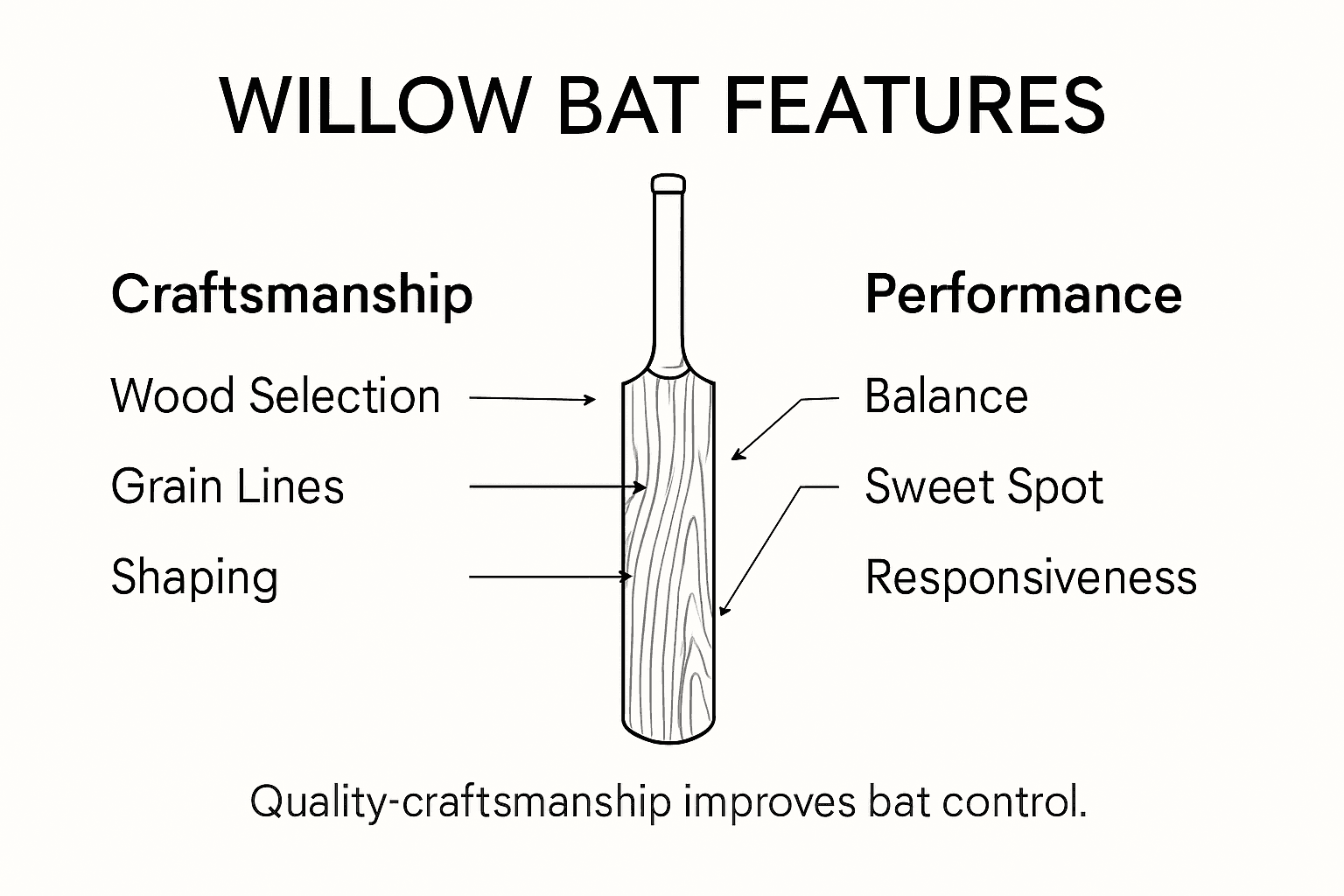
The shaping and pressing of English willow require extraordinary skill and precision. Craftsmen meticulously contour the bat’s profile, carefully balancing weight distribution, edge thickness, and spine height to create an implement that provides maximum power and control. Advanced pressing techniques compress the wood’s fibres, enhancing its natural shock-absorption properties and creating a denser, more responsive batting surface that can withstand the intense impacts of competitive cricket.
Expert tip: Examine a cricket bat’s craftsmanship by checking its grain alignment, weight balance, and surface smoothness, as these elements directly indicate the quality of its manufacturing process.
How English willow bats improve performance
English willow bats significantly enhance cricket performance through their unique material properties and advanced structural design. The wood’s exceptional shock absorption characteristics allow players to generate maximum power while minimising energy loss during ball impact. Detailed bat manufacturing techniques reveal the intricate process behind these performance improvements, demonstrating the sophisticated engineering involved in creating superior cricket equipment.
The natural cellular structure of English willow provides unparalleled responsiveness and energy transfer. When a cricket ball strikes the bat, the wood’s dense fibres compress and release energy more efficiently than alternative timber varieties, resulting in greater ball velocity and improved shot precision. Professional players particularly value the material’s ability to maintain structural integrity under repeated high-impact strikes, which translates to consistent performance across extended playing periods.
Critical performance enhancements include superior weight distribution, enhanced sweet spot characteristics, and exceptional vibration dampening. The carefully crafted profile of English willow bats ensures optimal balance between bat weight and swing speed, allowing players to execute shots with increased control and minimal muscular fatigue. Advanced pressing techniques further compress the wood’s internal structure, creating a more responsive surface that maximises power transmission and minimises unwanted bat vibrations during ball contact.
Expert tip: Test a bat’s performance by gently tapping its surface and listening for a crisp, resonant sound, which indicates superior wood density and potential energy transfer capabilities.
Comparing English willow to Kashmir willow bats
The choice between English willow and Kashmir willow represents a critical decision for cricketers at different skill levels and budgetary considerations. Understanding the distinctive characteristics of each timber type helps players make informed bat selection choices, with each wood offering unique performance attributes that cater to specific playing requirements.
English willow stands as the premium option, characterised by its lighter weight, finer grain structure, and exceptional responsiveness. Professional cricketers consistently prefer this timber for its superior energy transfer, more pronounced sweet spots, and remarkable shock absorption capabilities. The wood’s natural cellular structure allows for enhanced ball striking performance, providing players with greater control and power during competitive matches. In contrast, Kashmir willow presents a more robust and dense alternative, typically featuring a heavier profile that offers increased durability but reduced finesse in shot-making.
Economic considerations play a significant role in bat selection, with Kashmir willow representing a more budget-friendly option for amateur and junior players. While Kashmir willow bats might lack the refined performance characteristics of English willow, they provide a solid, reliable option for players developing their skills or operating under financial constraints. The fundamental differences extend beyond price, encompassing wood density, grain structure, and overall playing characteristics that directly impact a cricketer’s performance and comfort during gameplay.
The following table compares key characteristics of English willow and Kashmir willow bats:
| Characteristic | English Willow | Kashmir Willow |
|---|---|---|
| Weight | Lighter, easy to swing | Heavier, requires effort |
| Grain Structure | Fine, straight grains | Coarser, less consistent |
| Shock Absorption | Excellent | Moderate |
| Price Range | High | Moderate to low |
| Typical User | Professionals, advanced | Juniors, beginners |
Expert tip: Consider your skill level, budget, and playing frequency when selecting between English and Kashmir willow bats, recognising that investing in quality equipment can significantly enhance your overall cricket experience.
Care, maintenance, and common mistakes to avoid
Caring for an English willow cricket bat requires meticulous attention and a systematic approach to preserve its performance characteristics and extend its operational lifespan. Proper bat maintenance techniques are crucial for protecting your investment in high-quality cricket equipment, ensuring consistent performance across multiple playing seasons.
Critical maintenance practices include careful moisture management and strategic protective measures. Wood conditioning represents a fundamental aspect of bat care, with players needing to apply linseed oil sparingly to prevent wood desiccation and maintain structural integrity. Avoid exposing the bat to extreme temperature variations or direct sunlight, which can cause structural warping or create microfractures in the wood’s cellular structure. Players should also invest in a quality bat cover to shield the equipment from environmental damage during storage and transportation, protecting the delicate willow surface from unnecessary wear and potential impact damage.
Common maintenance mistakes can significantly compromise bat performance and longevity. Improper knocking-in techniques, excessive moisture exposure, and neglecting routine inspection can accelerate bat deterioration. Amateur players frequently make errors such as using the bat without proper preparation, storing it in damp environments, or failing to address minor structural damages promptly. Developing a consistent maintenance routine involves regular visual inspections, gentle cleaning after use, and understanding the nuanced care requirements specific to English willow’s delicate composition.
Expert tip: Invest in a specialised bat maintenance kit and establish a routine inspection schedule to catch potential issues early, ensuring your cricket bat remains in optimal condition throughout its operational lifecycle.
Discover the Power of English Willow Bats with CricketBats.com
Choosing the right cricket bat can transform your game by enhancing power, control, and confidence. As highlighted in the article, English willow bats offer exceptional shock absorption, fine grain structure, and superior responsiveness. For players aiming to harness these performance benefits, selecting a high-quality bat crafted from premium English willow is essential to elevate your cricket experience.

Explore our extensive collection at Home page – Cricket Bats Com and find the ideal bat that matches your skill level and playing style. Whether you are a professional seeking Grade 1 bat excellence or an amateur ready to upgrade, our curated selection from trusted brands like Gunn & Moore ensures quality and durability. Don’t miss the opportunity to enhance your game with gear tailored for peak performance. Visit cricketbats.com today to experience premium cricket equipment along with expert advice and free shipping.
Frequently Asked Questions
What is an English willow bat?
English willow bats are made from Salix alba var. caerulea, a specific type of willow that offers exceptional density, flexibility, and shock absorption, making it ideal for high-performance cricket bats.
Why is English willow preferred over Kashmir willow for cricket bats?
English willow is lighter, has finer grain structure, and offers better shock absorption, resulting in superior energy transfer and control, making it the preferred choice for professional cricketers.
How can I ensure the best performance from my English willow bat?
To ensure optimal performance, maintain your bat by applying linseed oil, avoiding exposure to extreme temperatures, and using a bat cover during storage. Regular inspections for minor damages are also crucial.
What are the different grades of English willow bats and how do they affect performance?
English willow bats are graded from 1 to 5, with Grade 1 being the highest quality. Higher grades offer better performance characteristics, such as straight grains and fewer blemishes, while lower grades may have cosmetic flaws but can still provide satisfactory functionality.
Recommended
Most British amateur cricketers discover that choosing the right bat can fundamentally change their game. With over 85 percent of competitive players preferring English willow bats for their density and resilience, understanding the legacy and features of this iconic wood is crucial. Explore how English willow’s origins, craftsmanship, and performance benefits set it apart and learn what details matter most when shopping online for top-quality equipment.
Table of Contents
- English Willow Bats: Definition And Origins
- Types And Grades Of English Willow Bats
- Key Features And Craftsmanship Of English Willow
- How English Willow Bats Improve Performance
- Comparing English Willow To Kashmir Willow Bats
- Care, Maintenance, And Common Mistakes To Avoid
Key Takeaways
| Point | Details |
|---|---|
| Quality of English Willow | English willow is the premium choice for cricket bats due to its unique properties of density, flexibility, and shock absorption, making it ideal for high-performance equipment. |
| Grading System | English willow bats are graded from 1 to 5, with Grade 1 and Grade 2 being preferred by professionals and serious players due to their excellent performance characteristics. |
| Craftsmanship Importance | The craftsmanship of English willow bats, including grain alignment and pressing techniques, significantly affects their performance and longevity. |
| Maintenance Practices | Regular care, including moisture management and protective measures, is essential to prolong the lifespan and functionality of an English willow bat. |
English willow bats: Definition and origins
English willow, scientifically termed Salix alba var. caerulea, represents a unique timber variant that has become synonymous with premium cricket bat manufacturing. This specialised tree species originated in Asia but found its true potential when cultivated in the United Kingdom during the 18th century. Specialized plantations emerged to grow the precise trees required for bat production, establishing a remarkable legacy in cricket equipment development.
The transformation of English willow into cricket bat material is rooted in its exceptional structural characteristics. Unlike other timber varieties, this particular willow possesses remarkable density, flexibility, and shock absorption properties that make it ideal for crafting high-performance sporting equipment. Cricket bat manufacturers specifically select trees grown in regions like Gloucestershire, where unique soil conditions and cultivation techniques produce wood with optimal grain structure and resilience.
Historically, the development of English willow bats paralleled the formalization of cricket as a structured sport. As cricket rules became standardised in the late 18th and early 19th centuries, bat makers began experimenting with different wood types, ultimately discovering that English willow provided unparalleled performance characteristics. The tree’s ability to withstand repeated impacts while maintaining structural integrity made it the preferred material for serious cricketers seeking reliable sporting equipment.
Expert tip: When selecting an English willow bat, examine the wood’s grain lines carefully, as tighter and straighter grains typically indicate superior quality and potential performance.
Types and grades of English willow bats
Cricket bat manufacturers categorise English willow into several distinct grades, each representing a specific quality tier that impacts performance and pricing. The grading system typically ranges from Grade 1 (highest quality) to Grade 5 (lowest commercial grade), with professional players and serious enthusiasts predominantly selecting Grade 1 and Grade 2 bats for competitive play. Understanding these grades helps players make informed bat selection decisions.
Grade classifications are determined by several critical factors, including grain straightness, colour consistency, and the presence of visual imperfections. Grade 1 represents premium willow with perfectly straight grains, minimal blemishes, and exceptional structural integrity. These bats command the highest prices and are favoured by professional cricketers. Grade 2 bats feature slightly more cosmetic variations but maintain excellent performance characteristics, offering a balanced option for serious amateur players seeking high-quality equipment.
Lower grade bats (Grades 3-5) present more visible imperfections such as heartwood patches, uneven grain lines, or minor structural asymmetries. While these variations do not necessarily compromise bat performance, they significantly reduce aesthetic appeal and potentially impact long-term durability. Players on a budget often select these grades, understanding that functional performance can still be excellent despite cosmetic differences.
Here is a summary of English willow grades and their typical users:
| Willow Grade | Typical User | Main Attributes |
|---|---|---|
| Grade 1 | Professional cricketers | Perfect grains, rare blemishes |
| Grade 2 | Serious amateurs | Small visual marks, high performance |
| Grades 3-5 | Casual or budget players | More cosmetic flaws, solid function |
Expert tip: When evaluating English willow bat grades, remember that visual imperfections do not always indicate reduced performance potential, so prioritise structural integrity and professional recommendations over pure aesthetics.
Key features and craftsmanship of English willow
The craftsmanship of English willow cricket bats involves a meticulous process that transforms raw timber into high-performance sporting equipment. Master bat makers employ sophisticated techniques to select, prepare, and shape willow into precision instruments that meet the exacting demands of cricketers. Custom bat selection requires understanding these intricate manufacturing processes that distinguish exceptional cricket bats from ordinary wooden implements.
Primary craftsmanship features include careful wood selection, where only the most uniform and structurally sound sections of English willow are chosen. Grain alignment plays a critical role in bat performance, with expert craftsmen seeking straight, tight grains that indicate superior strength and resilience. The wood undergoes extensive preparation, including careful drying processes that can take several years, ensuring the timber develops optimal density, flexibility, and shock-absorption characteristics essential for high-quality cricket bat construction.
The shaping and pressing of English willow require extraordinary skill and precision. Craftsmen meticulously contour the bat’s profile, carefully balancing weight distribution, edge thickness, and spine height to create an implement that provides maximum power and control. Advanced pressing techniques compress the wood’s fibres, enhancing its natural shock-absorption properties and creating a denser, more responsive batting surface that can withstand the intense impacts of competitive cricket.
Expert tip: Examine a cricket bat’s craftsmanship by checking its grain alignment, weight balance, and surface smoothness, as these elements directly indicate the quality of its manufacturing process.
How English willow bats improve performance
English willow bats significantly enhance cricket performance through their unique material properties and advanced structural design. The wood’s exceptional shock absorption characteristics allow players to generate maximum power while minimising energy loss during ball impact. Detailed bat manufacturing techniques reveal the intricate process behind these performance improvements, demonstrating the sophisticated engineering involved in creating superior cricket equipment.
The natural cellular structure of English willow provides unparalleled responsiveness and energy transfer. When a cricket ball strikes the bat, the wood’s dense fibres compress and release energy more efficiently than alternative timber varieties, resulting in greater ball velocity and improved shot precision. Professional players particularly value the material’s ability to maintain structural integrity under repeated high-impact strikes, which translates to consistent performance across extended playing periods.
Critical performance enhancements include superior weight distribution, enhanced sweet spot characteristics, and exceptional vibration dampening. The carefully crafted profile of English willow bats ensures optimal balance between bat weight and swing speed, allowing players to execute shots with increased control and minimal muscular fatigue. Advanced pressing techniques further compress the wood’s internal structure, creating a more responsive surface that maximises power transmission and minimises unwanted bat vibrations during ball contact.
Expert tip: Test a bat’s performance by gently tapping its surface and listening for a crisp, resonant sound, which indicates superior wood density and potential energy transfer capabilities.
Comparing English willow to Kashmir willow bats
The choice between English willow and Kashmir willow represents a critical decision for cricketers at different skill levels and budgetary considerations. Understanding the distinctive characteristics of each timber type helps players make informed bat selection choices, with each wood offering unique performance attributes that cater to specific playing requirements.
English willow stands as the premium option, characterised by its lighter weight, finer grain structure, and exceptional responsiveness. Professional cricketers consistently prefer this timber for its superior energy transfer, more pronounced sweet spots, and remarkable shock absorption capabilities. The wood’s natural cellular structure allows for enhanced ball striking performance, providing players with greater control and power during competitive matches. In contrast, Kashmir willow presents a more robust and dense alternative, typically featuring a heavier profile that offers increased durability but reduced finesse in shot-making.
Economic considerations play a significant role in bat selection, with Kashmir willow representing a more budget-friendly option for amateur and junior players. While Kashmir willow bats might lack the refined performance characteristics of English willow, they provide a solid, reliable option for players developing their skills or operating under financial constraints. The fundamental differences extend beyond price, encompassing wood density, grain structure, and overall playing characteristics that directly impact a cricketer’s performance and comfort during gameplay.
The following table compares key characteristics of English willow and Kashmir willow bats:
| Characteristic | English Willow | Kashmir Willow |
|---|---|---|
| Weight | Lighter, easy to swing | Heavier, requires effort |
| Grain Structure | Fine, straight grains | Coarser, less consistent |
| Shock Absorption | Excellent | Moderate |
| Price Range | High | Moderate to low |
| Typical User | Professionals, advanced | Juniors, beginners |
Expert tip: Consider your skill level, budget, and playing frequency when selecting between English and Kashmir willow bats, recognising that investing in quality equipment can significantly enhance your overall cricket experience.
Care, maintenance, and common mistakes to avoid
Caring for an English willow cricket bat requires meticulous attention and a systematic approach to preserve its performance characteristics and extend its operational lifespan. Proper bat maintenance techniques are crucial for protecting your investment in high-quality cricket equipment, ensuring consistent performance across multiple playing seasons.
Critical maintenance practices include careful moisture management and strategic protective measures. Wood conditioning represents a fundamental aspect of bat care, with players needing to apply linseed oil sparingly to prevent wood desiccation and maintain structural integrity. Avoid exposing the bat to extreme temperature variations or direct sunlight, which can cause structural warping or create microfractures in the wood’s cellular structure. Players should also invest in a quality bat cover to shield the equipment from environmental damage during storage and transportation, protecting the delicate willow surface from unnecessary wear and potential impact damage.
Common maintenance mistakes can significantly compromise bat performance and longevity. Improper knocking-in techniques, excessive moisture exposure, and neglecting routine inspection can accelerate bat deterioration. Amateur players frequently make errors such as using the bat without proper preparation, storing it in damp environments, or failing to address minor structural damages promptly. Developing a consistent maintenance routine involves regular visual inspections, gentle cleaning after use, and understanding the nuanced care requirements specific to English willow’s delicate composition.
Expert tip: Invest in a specialised bat maintenance kit and establish a routine inspection schedule to catch potential issues early, ensuring your cricket bat remains in optimal condition throughout its operational lifecycle.
Discover the Power of English Willow Bats with CricketBats.com
Choosing the right cricket bat can transform your game by enhancing power, control, and confidence. As highlighted in the article, English willow bats offer exceptional shock absorption, fine grain structure, and superior responsiveness. For players aiming to harness these performance benefits, selecting a high-quality bat crafted from premium English willow is essential to elevate your cricket experience.
Explore our extensive collection at Home page – Cricket Bats Com and find the ideal bat that matches your skill level and playing style. Whether you are a professional seeking Grade 1 bat excellence or an amateur ready to upgrade, our curated selection from trusted brands like Gunn & Moore ensures quality and durability. Don’t miss the opportunity to enhance your game with gear tailored for peak performance. Visit cricketbats.com today to experience premium cricket equipment along with expert advice and free shipping.
Frequently Asked Questions
What is an English willow bat?
English willow bats are made from Salix alba var. caerulea, a specific type of willow that offers exceptional density, flexibility, and shock absorption, making it ideal for high-performance cricket bats.
Why is English willow preferred over Kashmir willow for cricket bats?
English willow is lighter, has finer grain structure, and offers better shock absorption, resulting in superior energy transfer and control, making it the preferred choice for professional cricketers.
How can I ensure the best performance from my English willow bat?
To ensure optimal performance, maintain your bat by applying linseed oil, avoiding exposure to extreme temperatures, and using a bat cover during storage. Regular inspections for minor damages are also crucial.
What are the different grades of English willow bats and how do they affect performance?
English willow bats are graded from 1 to 5, with Grade 1 being the highest quality. Higher grades offer better performance characteristics, such as straight grains and fewer blemishes, while lower grades may have cosmetic flaws but can still provide satisfactory functionality.