
News News
Cricket Bat Grading Step by Step for Accurate Selection Cricket Bat Grading Step by Step for Accurate Selection
Choosing the best cricket bat can feel overwhelming, especially with so many subtle differences that affect how you play. For anyone serious about improving their game, understanding how to grade a cricket bat is a vital skill that separates confident players from the rest. This step-by-step guide breaks down what to look for, covering everything from workspace setup to sound testing, to help you make a smart, informed choice before you invest in your next bat.
Table of Contents
- Step 1: Prepare Tools And Workspace For Grading
- Step 2: Inspect Willow Type And Grain Quality
- Step 3: Evaluate Weight, Balance And Handle Construction
- Step 4: Assess Surface Finish And Pressing Consistency
- Step 5: Test For Rebound And Sound Response
- Step 6: Confirm Grading And Record Findings
Quick Summary
| Key Point | Explanation |
|---|---|
| 1. Prepare a clean workspace | A well-lit, clutter-free area ensures accurate bat grading and prevents accidental damage during inspection. |
| 2. Inspect willow type and grain | Understanding the willow grade affects the bat’s performance, durability, and overall value, so assess grain quality closely. |
| 3. Evaluate weight and balance | Weight and balance impact your batting style; light bats suit defensive players, while heavier bats cater to power hitters. |
| 4. Check surface finish consistency | A uniform surface finish enhances durability; look for smoothness and minimal imperfections. |
| 5. Test rebound and sound response | The bat’s sound and bounce reveal key insights into its responsiveness and potential performance during play. |
Step 1: Prepare tools and workspace for grading
Preparing the right workspace and gathering appropriate tools are crucial first steps in accurately grading a cricket bat. You’ll want to create a clean, well-lit environment with a stable surface that allows you to examine the bat thoroughly and systematically.
To get started, collect the essential tools you’ll need for bat grading. These include:
- A clean, flat surface like a workbench or sturdy table
- Bright lighting (natural daylight or a strong lamp)
- Measuring tape for precise length and width measurements
- White chalk or marking pencil for notation
- Magnifying glass to inspect wood grain and surface details
- Clean microfibre cloth for wiping down the bat
Position your workspace near a window or under good lighting to ensure you can see every detail of the cricket bat. Natural daylight provides the most accurate colour and texture assessment. Avoid cluttered areas that might cause accidental damage to the bat during inspection.
Proper workspace preparation is 50% of successful bat grading.
Cleanliness is key. Before starting, wipe down your workspace and ensure your hands are clean to prevent transferring oils or dirt onto the bat’s surface. Handle the bat carefully, supporting its weight evenly and avoiding excessive pressure on any single area.
Pro tip: Always wear clean, lint-free cotton gloves when handling premium cricket bats to prevent skin oils from affecting the wood’s surface condition.
Step 2: Inspect willow type and grain quality
Inspecting the willow type and grain quality is a critical step in grading a cricket bat. This process helps you understand the bat’s potential performance, durability, and overall value by examining its most fundamental structural characteristics.
Start by identifying the willow grade of the bat. Cricket bats are typically made from two primary types of willow:
Here’s a comparison of key differences between English willow and Kashmir willow for cricket bats:
| Characteristic | English Willow | Kashmir Willow |
|---|---|---|
| Origin | United Kingdom | India/Pakistan |
| Performance | High power, superior rebound | Good power, less responsive |
| Appearance | Lighter, clean-grained look | Darker, coarser grain |
| Durability | Softer, may mark easily | Harder, resists impact marks |
| Price Range | More expensive | More affordable |
- English willow: Considered premium, softer, and more responsive
- Kashmir willow: More affordable, harder, and slightly less flexible
Carefully examine the wood’s grain pattern. High-quality cricket bats feature straight, even grains running parallel to each other. Look for these key characteristics:
- Grain width: Ideal bats have 6-12 narrow, straight grains across the bat’s face
- Grain consistency: Uniform grains indicate superior wood quality
- Colour variation: Lighter coloured willow often suggests better performance potential
Grain quality directly impacts a cricket bat’s responsiveness and power transmission.
Use your magnifying glass to inspect the wood closely. Check for any imperfections such as knots, uneven grain lines, or discolouration that might compromise the bat’s structural integrity. These visual cues can significantly influence the bat’s grading and potential performance.
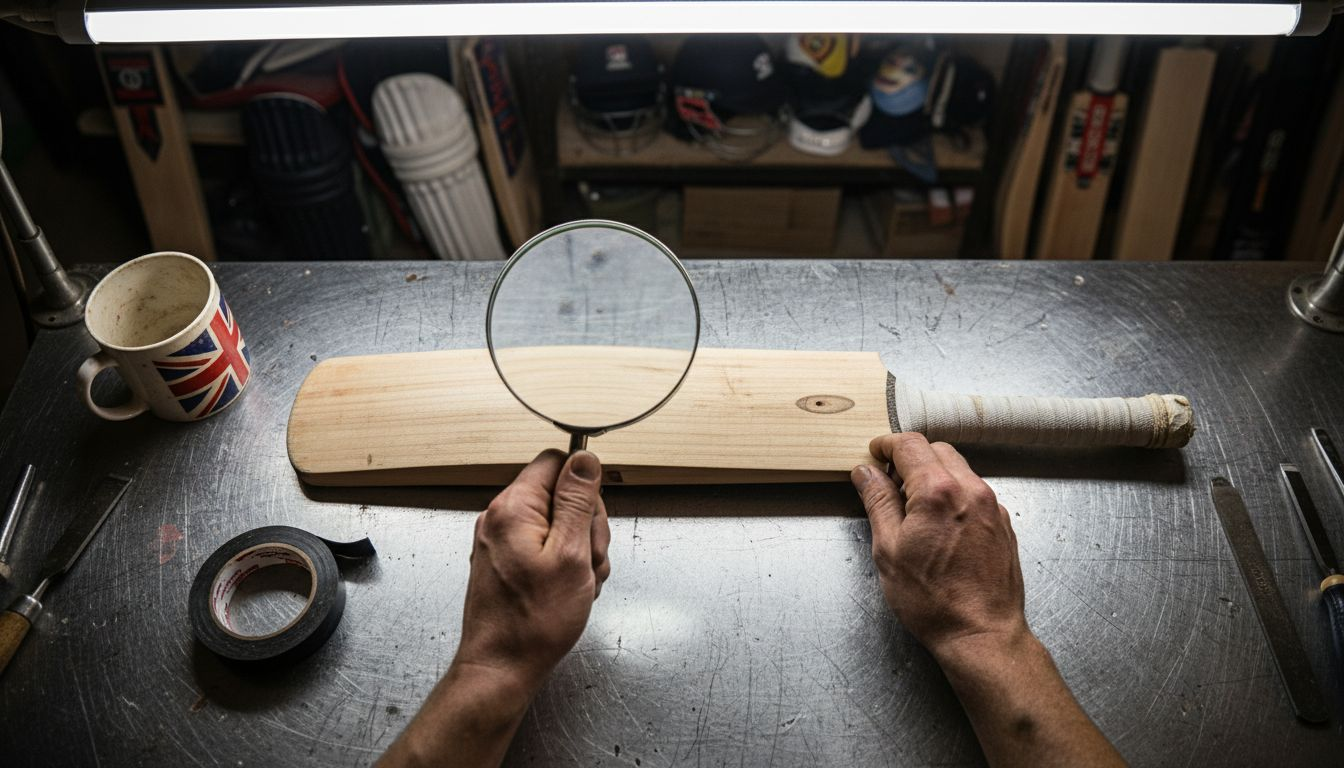
Pro tip: Rotate the bat under bright light to reveal subtle grain details and potential hidden wood characteristics that might affect its overall quality.
Step 3: Evaluate weight, balance and handle construction
Evaluating a cricket bat’s weight, balance, and handle construction is crucial for finding the perfect match for your playing style. Cricket bat selection requires a nuanced understanding of how these elements interact to influence your performance on the pitch.
Weight plays a fundamental role in bat selection. Cricket bats typically range between 2.4 to 2.7 pounds, with each weight offering distinct advantages:
- Light bats (2.4-2.5 lbs): Ideal for defensive players and younger cricketers
- Medium-weight bats (2.5-2.6 lbs): Balanced option for most players
- Heavy bats (2.6-2.7 lbs): Preferred by power hitters and experienced batsmen
Balance determines how the bat feels when you swing. You’ll want to assess three key balance points:
- Top-heavy bats: Provide more power for aggressive shots
- Middle-balanced bats: Offer versatile performance
- Bottom-heavy bats: Enhance manoeuvrability and quick reactions
The perfect bat weight and balance can transform your batting technique.
Handle construction is equally critical. Examine the handle’s material, typically made from cane or composite materials. Look for:
- Oval handle: Provides better grip and reduces bat twisting
- Round handle: Offers more traditional feel
- Vibration absorption capabilities
- Smooth, consistent wrapping
Pro tip: Always test the bat’s weight and balance by holding it with your dominant hand and performing practice swings to feel its natural movement.
Step 4: Assess surface finish and pressing consistency
Evaluating the surface finish and pressing consistency is a critical step in determining a cricket bat’s quality and potential performance. Cricket bat blade grading requires meticulous attention to detail and a systematic approach to understanding how manufacturing processes impact the bat’s structural integrity.
Begin by examining the bat’s surface finish for these key characteristics:
- Smoothness: Uniform surface without visible imperfections
- Colour consistency: Consistent white or light cream tone
- Texture: Even grain pattern without rough spots
- Compression marks: Minimal and evenly distributed
Pressing consistency is fundamental to a bat’s performance. Look for these critical indicators:
- Uniform compression: Even pressure across the bat’s surface
- No visible compression lines: Smooth, consistent appearance
- Balanced fiber alignment: Straight, parallel grain lines
- Absence of deep indentations: Smooth pressing technique
Inconsistent pressing can significantly compromise a cricket bat’s durability and performance.
Use your magnifying glass to inspect the subtle details of the surface. Check for signs of over-pressing or uneven compression that might compromise the bat’s structural integrity. Pay special attention to the edges and middle of the bat, where manufacturing inconsistencies are most likely to occur.
Pro tip: Run your fingers gently across the bat’s surface to feel subtle variations in pressing and finish that might not be immediately visible to the naked eye.
Step 5: Test for rebound and sound response
Testing a cricket bat’s rebound and sound response provides crucial insights into its potential performance and structural quality. Tapping test reliability involves interpreting subtle acoustic and vibration characteristics that reveal the bat’s inherent elasticity and responsiveness.
Perform the sound response test using these systematic steps:
- Hold the bat vertically, supporting it at the shoulder
- Tap the bat’s surface gently with your knuckle or a small wooden mallet
- Listen carefully to the resulting sound
- Assess the quality of the acoustic response
Listen for these critical sound characteristics:
- Clear, sharp ‘ping’: Indicates excellent bat responsiveness
- Dull or muted sound: Suggests potential internal structural issues
- Consistent tone: Demonstrates uniform wood density
- Resonance duration: Longer resonance typically signals better bat quality
The bat’s sound can reveal more about its performance than visual inspection alone.
Rebound testing complements the sound assessment. Drop the bat from a consistent height and observe how it bounces, checking for:
- Consistent bounce height
- Minimal vibration after impact
- Quick energy transfer
- Smooth, predictable rebound
Pro tip: Perform multiple taps at different bat locations to ensure consistent sound response and identify any potential weak spots.
Step 6: Confirm grading and record findings
The final stage of cricket bat grading involves systematically documenting your comprehensive evaluation and assigning an official grade that reflects the bat’s overall quality and performance potential. This critical process transforms your detailed observations into a structured assessment that can guide purchasing or selection decisions.
Create a structured grading document with these essential components:
- Willow grade classification
- Weight measurements
- Balance assessment
- Surface finish rating
- Sound response evaluation
- Pressing consistency score
Record your findings using a standardised scoring system:
- Numerical scoring: Rate each characteristic on a 1-10 scale
- Written description: Provide contextual notes
- Photographic evidence: Capture detailed images of key observations
- Condition notes: Document any potential manufacturing variations
A thorough, objective grading process ensures accurate bat evaluation.
Evaluate the cumulative score across all assessment criteria to determine the final overall grade. Consider how each characteristic contributes to the bat’s potential performance and durability.
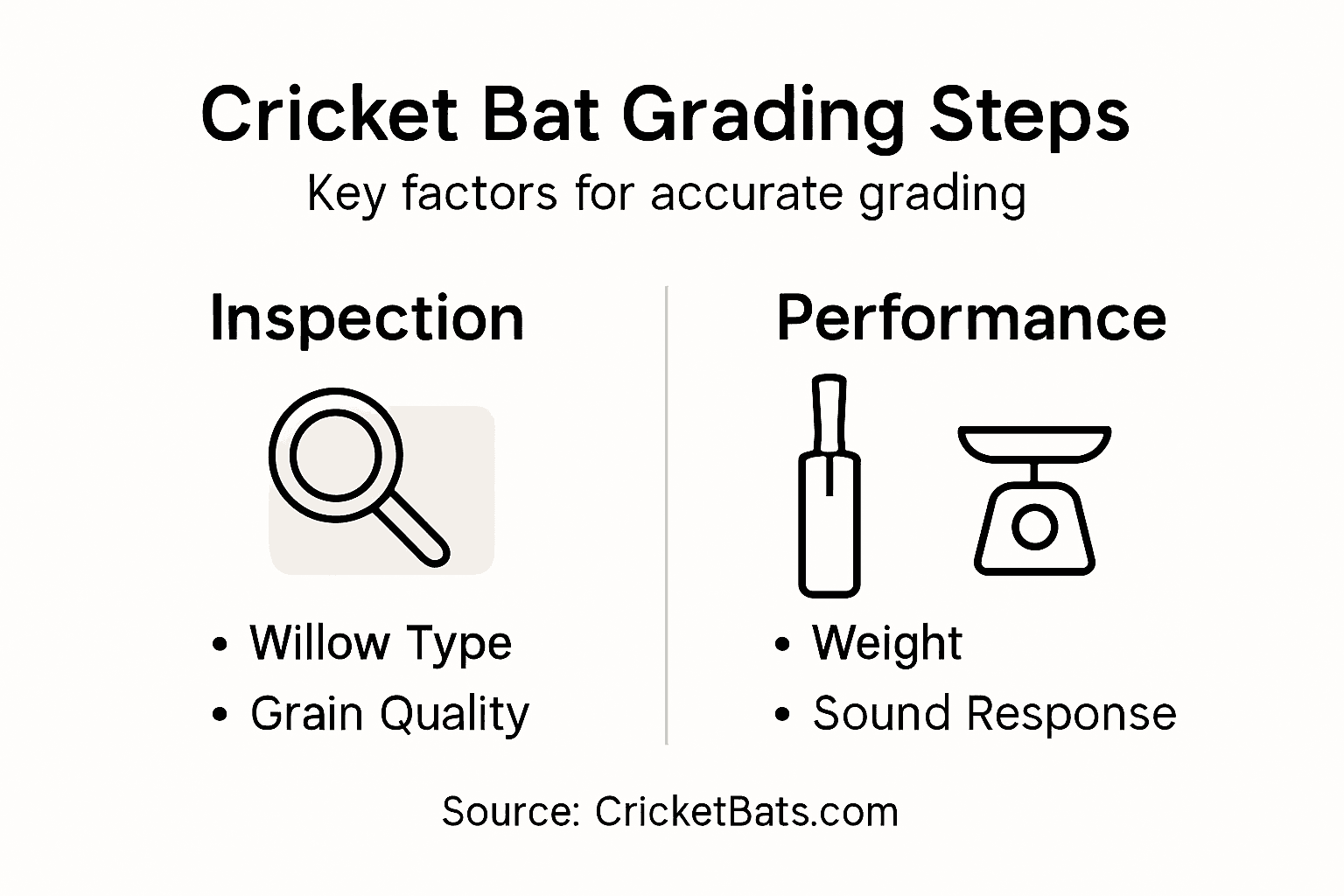
Below is a summary of typical cricket bat grading criteria and their impact on bat quality:
| Grading Factor | What to Assess | Impact on Performance |
|---|---|---|
| Willow Type | Grade and origin | Determines quality and feel |
| Grain Quality | Number and consistency | Affects power transmission |
| Weight & Balance | Distribution, weight | Influences play style |
| Surface Finish | Smoothness, texture | Enhances durability |
| Sound & Rebound | Acoustic response | Reveals internal integrity |
| Pressing Consistency | Uniform compression | Supports even power delivery |
Pro tip: Use a waterproof, tear-resistant documentation template to create consistent, long-lasting grading records that can be referenced in future assessments.
Find the Perfect Cricket Bat with Confidence at CricketBats.com
Grading a cricket bat step by step reveals how crucial it is to assess willow type, grain quality, weight, balance, and pressing consistency before making a choice. If you have struggled to select a bat that truly matches your playing style and performance goals, you are not alone. Many players face the challenge of identifying bats with ideal responsiveness and durability, especially when factors like sound response and rebound come into play.

Explore our curated collection at New Balance Cricket Bats – Cricket Bats Com to discover expertly crafted bats that meet rigorous grading standards. Whether you need a precise fit for your technique or a reliable bat with consistent pressing and grain quality, our range supports you. Start your bat selection journey at our Home page – Cricket Bats Com and browse through options including gear for younger players at Junior Cricket Bats | Cheap Junior Cricket Bats – Cricket Bats Com so you never compromise on quality or feel.
Visit https://cricketbats.com now and own a bat graded for excellence that can transform your game today.
Frequently Asked Questions
What tools do I need for proper cricket bat grading?
To accurately grade a cricket bat, you will need a clean, flat surface, bright lighting, a measuring tape, a marking pencil, a magnifying glass, and a clean microfibre cloth. Gather these tools to ensure a thorough evaluation of the bat’s condition and quality.
How can I evaluate the willow type and grain quality of a cricket bat?
Begin by identifying whether the bat is made from English or Kashmir willow, and then inspect the wood’s grain pattern. Look for straight, even grains with 6-12 narrow lines across the face, as these indicate higher quality and better performance potential.
What factors should I consider when assessing the weight and balance of a cricket bat?
When assessing a cricket bat’s weight, note that they typically range from 2.4 to 2.7 pounds, affecting power and swing. Evaluate its balance by identifying whether it is top-heavy, middle-balanced, or bottom-heavy to determine how it suits your playing style.
How do I test the surface finish and pressing consistency of a cricket bat?
Examine the bat’s surface for smoothness, colour consistency, and minimal compression marks. Use a magnifying glass to check for even compression and straight grain lines, ensuring the bat maintains its structural integrity and performance.
What should I look for during the rebound and sound response test of a cricket bat?
Conduct the sound response test by tapping the bat and listening for a clear, sharp ‘ping,’ which indicates good responsiveness. Assess the rebound by dropping the bat from a consistent height to check for predictable bounce and energy transfer, which are crucial for performance.
How can I document my findings and confirm the grading of a cricket bat?
Create a structured grading document that includes rates for willow grade, weight, balance, surface finish, and sound response. Keep detailed notes and photographs to support your evaluation, ensuring all data is organised for future reference.
Recommended
Choosing the best cricket bat can feel overwhelming, especially with so many subtle differences that affect how you play. For anyone serious about improving their game, understanding how to grade a cricket bat is a vital skill that separates confident players from the rest. This step-by-step guide breaks down what to look for, covering everything from workspace setup to sound testing, to help you make a smart, informed choice before you invest in your next bat.
Table of Contents
- Step 1: Prepare Tools And Workspace For Grading
- Step 2: Inspect Willow Type And Grain Quality
- Step 3: Evaluate Weight, Balance And Handle Construction
- Step 4: Assess Surface Finish And Pressing Consistency
- Step 5: Test For Rebound And Sound Response
- Step 6: Confirm Grading And Record Findings
Quick Summary
| Key Point | Explanation |
|---|---|
| 1. Prepare a clean workspace | A well-lit, clutter-free area ensures accurate bat grading and prevents accidental damage during inspection. |
| 2. Inspect willow type and grain | Understanding the willow grade affects the bat’s performance, durability, and overall value, so assess grain quality closely. |
| 3. Evaluate weight and balance | Weight and balance impact your batting style; light bats suit defensive players, while heavier bats cater to power hitters. |
| 4. Check surface finish consistency | A uniform surface finish enhances durability; look for smoothness and minimal imperfections. |
| 5. Test rebound and sound response | The bat’s sound and bounce reveal key insights into its responsiveness and potential performance during play. |
Step 1: Prepare tools and workspace for grading
Preparing the right workspace and gathering appropriate tools are crucial first steps in accurately grading a cricket bat. You’ll want to create a clean, well-lit environment with a stable surface that allows you to examine the bat thoroughly and systematically.
To get started, collect the essential tools you’ll need for bat grading. These include:
- A clean, flat surface like a workbench or sturdy table
- Bright lighting (natural daylight or a strong lamp)
- Measuring tape for precise length and width measurements
- White chalk or marking pencil for notation
- Magnifying glass to inspect wood grain and surface details
- Clean microfibre cloth for wiping down the bat
Position your workspace near a window or under good lighting to ensure you can see every detail of the cricket bat. Natural daylight provides the most accurate colour and texture assessment. Avoid cluttered areas that might cause accidental damage to the bat during inspection.
Proper workspace preparation is 50% of successful bat grading.
Cleanliness is key. Before starting, wipe down your workspace and ensure your hands are clean to prevent transferring oils or dirt onto the bat’s surface. Handle the bat carefully, supporting its weight evenly and avoiding excessive pressure on any single area.
Pro tip: Always wear clean, lint-free cotton gloves when handling premium cricket bats to prevent skin oils from affecting the wood’s surface condition.
Step 2: Inspect willow type and grain quality
Inspecting the willow type and grain quality is a critical step in grading a cricket bat. This process helps you understand the bat’s potential performance, durability, and overall value by examining its most fundamental structural characteristics.
Start by identifying the willow grade of the bat. Cricket bats are typically made from two primary types of willow:
Here’s a comparison of key differences between English willow and Kashmir willow for cricket bats:
| Characteristic | English Willow | Kashmir Willow |
|---|---|---|
| Origin | United Kingdom | India/Pakistan |
| Performance | High power, superior rebound | Good power, less responsive |
| Appearance | Lighter, clean-grained look | Darker, coarser grain |
| Durability | Softer, may mark easily | Harder, resists impact marks |
| Price Range | More expensive | More affordable |
- English willow: Considered premium, softer, and more responsive
- Kashmir willow: More affordable, harder, and slightly less flexible
Carefully examine the wood’s grain pattern. High-quality cricket bats feature straight, even grains running parallel to each other. Look for these key characteristics:
- Grain width: Ideal bats have 6-12 narrow, straight grains across the bat’s face
- Grain consistency: Uniform grains indicate superior wood quality
- Colour variation: Lighter coloured willow often suggests better performance potential
Grain quality directly impacts a cricket bat’s responsiveness and power transmission.
Use your magnifying glass to inspect the wood closely. Check for any imperfections such as knots, uneven grain lines, or discolouration that might compromise the bat’s structural integrity. These visual cues can significantly influence the bat’s grading and potential performance.
Pro tip: Rotate the bat under bright light to reveal subtle grain details and potential hidden wood characteristics that might affect its overall quality.
Step 3: Evaluate weight, balance and handle construction
Evaluating a cricket bat’s weight, balance, and handle construction is crucial for finding the perfect match for your playing style. Cricket bat selection requires a nuanced understanding of how these elements interact to influence your performance on the pitch.
Weight plays a fundamental role in bat selection. Cricket bats typically range between 2.4 to 2.7 pounds, with each weight offering distinct advantages:
- Light bats (2.4-2.5 lbs): Ideal for defensive players and younger cricketers
- Medium-weight bats (2.5-2.6 lbs): Balanced option for most players
- Heavy bats (2.6-2.7 lbs): Preferred by power hitters and experienced batsmen
Balance determines how the bat feels when you swing. You’ll want to assess three key balance points:
- Top-heavy bats: Provide more power for aggressive shots
- Middle-balanced bats: Offer versatile performance
- Bottom-heavy bats: Enhance manoeuvrability and quick reactions
The perfect bat weight and balance can transform your batting technique.
Handle construction is equally critical. Examine the handle’s material, typically made from cane or composite materials. Look for:
- Oval handle: Provides better grip and reduces bat twisting
- Round handle: Offers more traditional feel
- Vibration absorption capabilities
- Smooth, consistent wrapping
Pro tip: Always test the bat’s weight and balance by holding it with your dominant hand and performing practice swings to feel its natural movement.
Step 4: Assess surface finish and pressing consistency
Evaluating the surface finish and pressing consistency is a critical step in determining a cricket bat’s quality and potential performance. Cricket bat blade grading requires meticulous attention to detail and a systematic approach to understanding how manufacturing processes impact the bat’s structural integrity.
Begin by examining the bat’s surface finish for these key characteristics:
- Smoothness: Uniform surface without visible imperfections
- Colour consistency: Consistent white or light cream tone
- Texture: Even grain pattern without rough spots
- Compression marks: Minimal and evenly distributed
Pressing consistency is fundamental to a bat’s performance. Look for these critical indicators:
- Uniform compression: Even pressure across the bat’s surface
- No visible compression lines: Smooth, consistent appearance
- Balanced fiber alignment: Straight, parallel grain lines
- Absence of deep indentations: Smooth pressing technique
Inconsistent pressing can significantly compromise a cricket bat’s durability and performance.
Use your magnifying glass to inspect the subtle details of the surface. Check for signs of over-pressing or uneven compression that might compromise the bat’s structural integrity. Pay special attention to the edges and middle of the bat, where manufacturing inconsistencies are most likely to occur.
Pro tip: Run your fingers gently across the bat’s surface to feel subtle variations in pressing and finish that might not be immediately visible to the naked eye.
Step 5: Test for rebound and sound response
Testing a cricket bat’s rebound and sound response provides crucial insights into its potential performance and structural quality. Tapping test reliability involves interpreting subtle acoustic and vibration characteristics that reveal the bat’s inherent elasticity and responsiveness.
Perform the sound response test using these systematic steps:
- Hold the bat vertically, supporting it at the shoulder
- Tap the bat’s surface gently with your knuckle or a small wooden mallet
- Listen carefully to the resulting sound
- Assess the quality of the acoustic response
Listen for these critical sound characteristics:
- Clear, sharp ‘ping’: Indicates excellent bat responsiveness
- Dull or muted sound: Suggests potential internal structural issues
- Consistent tone: Demonstrates uniform wood density
- Resonance duration: Longer resonance typically signals better bat quality
The bat’s sound can reveal more about its performance than visual inspection alone.
Rebound testing complements the sound assessment. Drop the bat from a consistent height and observe how it bounces, checking for:
- Consistent bounce height
- Minimal vibration after impact
- Quick energy transfer
- Smooth, predictable rebound
Pro tip: Perform multiple taps at different bat locations to ensure consistent sound response and identify any potential weak spots.
Step 6: Confirm grading and record findings
The final stage of cricket bat grading involves systematically documenting your comprehensive evaluation and assigning an official grade that reflects the bat’s overall quality and performance potential. This critical process transforms your detailed observations into a structured assessment that can guide purchasing or selection decisions.
Create a structured grading document with these essential components:
- Willow grade classification
- Weight measurements
- Balance assessment
- Surface finish rating
- Sound response evaluation
- Pressing consistency score
Record your findings using a standardised scoring system:
- Numerical scoring: Rate each characteristic on a 1-10 scale
- Written description: Provide contextual notes
- Photographic evidence: Capture detailed images of key observations
- Condition notes: Document any potential manufacturing variations
A thorough, objective grading process ensures accurate bat evaluation.
Evaluate the cumulative score across all assessment criteria to determine the final overall grade. Consider how each characteristic contributes to the bat’s potential performance and durability.
Below is a summary of typical cricket bat grading criteria and their impact on bat quality:
| Grading Factor | What to Assess | Impact on Performance |
|---|---|---|
| Willow Type | Grade and origin | Determines quality and feel |
| Grain Quality | Number and consistency | Affects power transmission |
| Weight & Balance | Distribution, weight | Influences play style |
| Surface Finish | Smoothness, texture | Enhances durability |
| Sound & Rebound | Acoustic response | Reveals internal integrity |
| Pressing Consistency | Uniform compression | Supports even power delivery |
Pro tip: Use a waterproof, tear-resistant documentation template to create consistent, long-lasting grading records that can be referenced in future assessments.
Find the Perfect Cricket Bat with Confidence at CricketBats.com
Grading a cricket bat step by step reveals how crucial it is to assess willow type, grain quality, weight, balance, and pressing consistency before making a choice. If you have struggled to select a bat that truly matches your playing style and performance goals, you are not alone. Many players face the challenge of identifying bats with ideal responsiveness and durability, especially when factors like sound response and rebound come into play.
Explore our curated collection at New Balance Cricket Bats – Cricket Bats Com to discover expertly crafted bats that meet rigorous grading standards. Whether you need a precise fit for your technique or a reliable bat with consistent pressing and grain quality, our range supports you. Start your bat selection journey at our Home page – Cricket Bats Com and browse through options including gear for younger players at Junior Cricket Bats | Cheap Junior Cricket Bats – Cricket Bats Com so you never compromise on quality or feel.
Visit https://cricketbats.com now and own a bat graded for excellence that can transform your game today.
Frequently Asked Questions
What tools do I need for proper cricket bat grading?
To accurately grade a cricket bat, you will need a clean, flat surface, bright lighting, a measuring tape, a marking pencil, a magnifying glass, and a clean microfibre cloth. Gather these tools to ensure a thorough evaluation of the bat’s condition and quality.
How can I evaluate the willow type and grain quality of a cricket bat?
Begin by identifying whether the bat is made from English or Kashmir willow, and then inspect the wood’s grain pattern. Look for straight, even grains with 6-12 narrow lines across the face, as these indicate higher quality and better performance potential.
What factors should I consider when assessing the weight and balance of a cricket bat?
When assessing a cricket bat’s weight, note that they typically range from 2.4 to 2.7 pounds, affecting power and swing. Evaluate its balance by identifying whether it is top-heavy, middle-balanced, or bottom-heavy to determine how it suits your playing style.
How do I test the surface finish and pressing consistency of a cricket bat?
Examine the bat’s surface for smoothness, colour consistency, and minimal compression marks. Use a magnifying glass to check for even compression and straight grain lines, ensuring the bat maintains its structural integrity and performance.
What should I look for during the rebound and sound response test of a cricket bat?
Conduct the sound response test by tapping the bat and listening for a clear, sharp ‘ping,’ which indicates good responsiveness. Assess the rebound by dropping the bat from a consistent height to check for predictable bounce and energy transfer, which are crucial for performance.
How can I document my findings and confirm the grading of a cricket bat?
Create a structured grading document that includes rates for willow grade, weight, balance, surface finish, and sound response. Keep detailed notes and photographs to support your evaluation, ensuring all data is organised for future reference.